

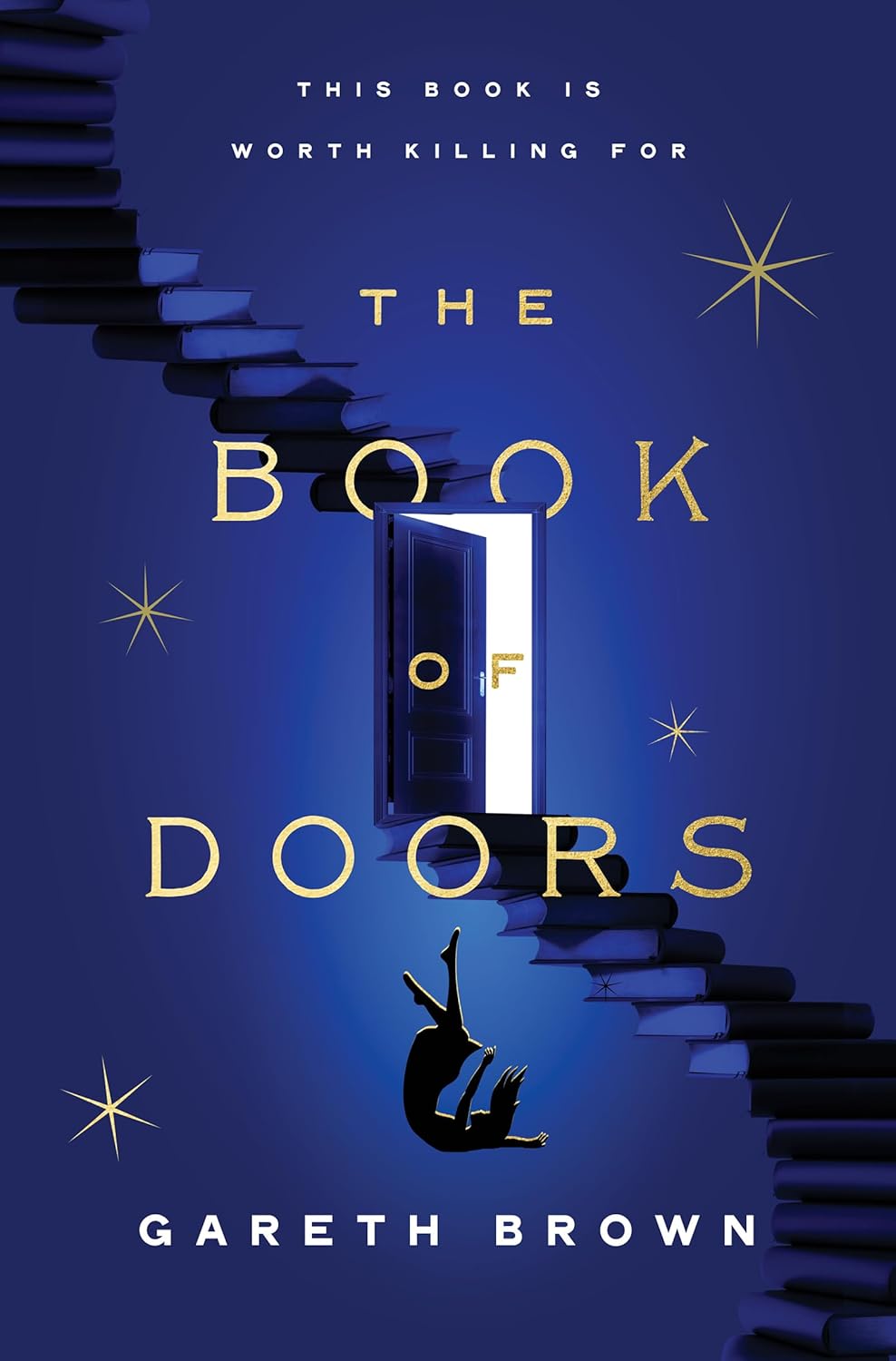
📋 Book Profile
Voto: 3,75/5
Title: The Book of Doors
Author: Gareth Brown
Genere: Fantasy/Paranormal
My Rating:
The Book of Doors – Gareth Brown
Rating: 3/5
Plot (spoiler-free)
Cassie works as a bookseller in New York, in a shop with a little café corner frequented by regulars. One of them, an elderly man, dies right there in the store, and leaves her something strange in his will: the Book of Doors. All she has to do is hold it, think of a door she’s already seen in real life (the important thing being that it isn’t locked), turn the handle, and she finds herself there. From this premise unfolds an adventure that blends fantasy, mystery, and chases, as Cassie quickly discovers she’s not the only one who knows these magical books exist, and that some people are willing to kill to get their hands on one.
What worked
- The premise. A book that turns any door into a portal to anywhere is a simple but effective hook, and the opening pages really do pull you in and get you curious.
- The variety of magic books. Beyond the Book of Doors, the author builds out a whole “system” of books with different powers, despair, pain, fog, shadow, joy, health, light, matter, which widens the world and makes it genuinely fun to find out, chapter by chapter, what each one can do.
- The antagonist. The Woman hunting down the books is ruthless through and through, she even killed her own parents just to test their powers, which makes her a real threat rather than a cardboard villain.
- The pull of the story. Despite the pacing dips, the book does what it needs to do: it kept me reading, even when it got a bit of a slog, right to the last page just to see how it would end.
What didn’t work
(Spoilers from here on)
- The pacing drags in the middle and toward the end. After a strong opening, the story slows down and gets harder to stay engaged with; at a certain point I was reading more to find out how it ended than for the pleasure of the story itself.
- The paradox of where the books come from. There’s a twist where Cassie, in the “non-place” she gets thrown into after her fight with the Woman, ends up, as the book explains through a passing thought, creating all the magic books herself, or rather, her consciousness does. But I kept wondering: if she’s creating them in that very moment, right after the fight and after losing her friend, just before waking up, how could they have already existed for decades, fought over by everyone? Why write them into existence at a point in the story where they’re already part of it?
- A few missed opportunities. In the scene where the shadow book is used to turn invisible in the car, I found it strange that they sit silently through a 13-hour car ride with the Woman without taking the chance to eliminate her while invisible, and then, even after finding out where she keeps the books, still don’t use their invisibility to take her out. She’s kept alive instead, seemingly just so she can be shown, shortly after, killing two random men to test the powers of the two new books she’d just gotten her hands on.
- A rule that didn’t quite hold up for me. If the Book of Doors only works when the departure/destination door isn’t locked, the scene where the books are stolen from a (by definition, locked) safe seems to contradict the very rule the novel had just laid out.
The book’s point is that “time travel” doesn’t change the outcome in the present, because whatever you do in the past, even when you think you’re changing it, is exactly what was always supposed to happen. But then Cassie makes a deal with the bookseller to save her friend that day, keeping her from staying home, so the author sets up rules and then breaks them. - A choice by the antagonist I struggled to justify. During the showdown at the auction, Cassie ends up, not even entirely clear how, in the “non-place” where she’ll go on to create the books herself; and later, in the final confrontation, instead of killing the Woman, they send her to that exact same place. I kept wondering why: if that’s where Cassie created those books in the first place, why risk letting the Woman go through the same process, possibly with even worse results, given the dark side she carries (a fragment of pain extracted from Barbary, the other antagonist)?
In short
An original starting idea and a genuinely gripping first act that, in my view, aren’t quite backed up by a solid internal logic: the further the story goes with time travel and reveals, the more inconsistencies I noticed, the kind a tighter edit might have smoothed out. I finished it more out of curiosity to see how it would end than for the pleasure of the read itself. Still, it’s a book that can entertain anyone who enjoys urban fantasy with a touch of mystery, as long as you don’t stop to think too hard about the details.dettagli.
Leave a Reply